
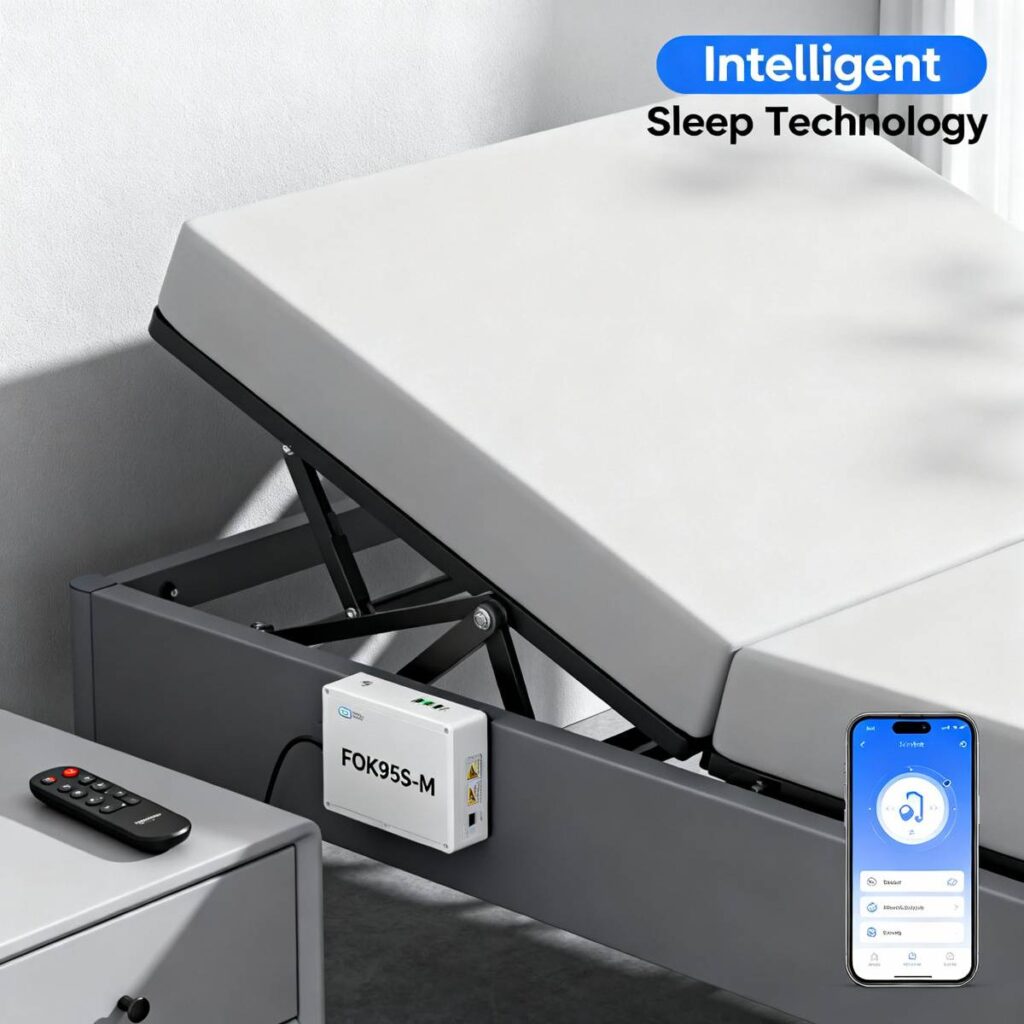
Understanding FOK959S-M Smart Bed Technology
The FOK959S-M designation in smart bed applications specifically refers to the control system that manages the bed’s motorized functions, sensor inputs, and smart features. Think of it as the brain of your adjustable bed—it receives commands from your remote or smartphone app, processes sensor data about your sleep patterns, and controls the motors that adjust your bed position throughout the night.
What sets the FOK959S-M apart from basic adjustable bed controllers is its integration capability. This isn’t just an up-down controller with a couple of preset positions. The system can coordinate multiple motors simultaneously, process real-time data from embedded sensors, connect to your home network for app control, and even integrate with other smart home devices. Some variants include AI-driven features that learn your preferences over time and make automatic adjustments to optimize your sleep quality.
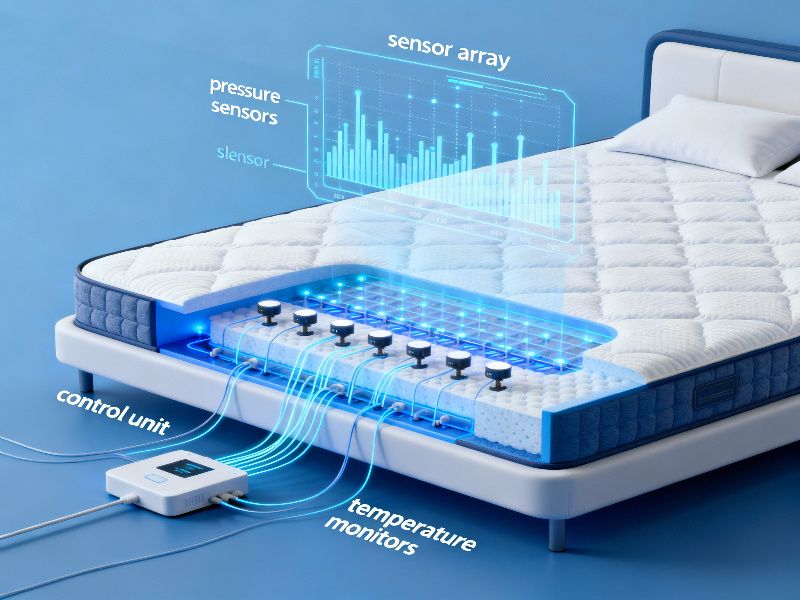
The technology works through a distributed system. Pressure sensors embedded in the mattress detect your position and movement. Temperature sensors monitor surface temperature. Some advanced implementations even include heart rate and respiration monitoring through ballistocardiography—basically measuring the subtle movements your heartbeat creates. All this data feeds into the FOK959S-M controller, which processes it and can make adjustments automatically or provide insights through a companion app.
Key Components of the System
A complete FOK959S-M smart bed system typically includes several interconnected components. The control box houses the main processing unit and connects to wall power—this is where the FOK959S-M controller lives. Motor assemblies attach to the bed frame at various points, typically controlling head elevation, foot elevation, and sometimes lumbar support independently. The sensor array may be integrated into a specialized mattress pad or built directly into compatible mattresses.
User interfaces vary depending on the specific variant. Most systems include a wireless remote control with preset positions and manual adjustment controls. Many add smartphone app connectivity through Wi-Fi or Bluetooth, allowing you to control the bed, view sleep data, and configure settings from your phone. Premium implementations might include voice control integration with Amazon Alexa, Google Assistant, or Apple HomeKit, letting you adjust your bed with voice commands.
Understanding how these components work together helps you appreciate what you’re actually getting. This isn’t just a motorized bed with an app—it’s an integrated system designed to actively improve your sleep through precise positioning and monitoring capabilities that weren’t possible with traditional beds.
Features and Capabilities
Let’s get into the specific features that FOK959S-M smart bed technology enables. Not every implementation includes all of these—capabilities vary based on which variant you have and how the system is configured—but this represents what’s possible with this technology platform.
Adjustable Positioning
The fundamental feature is adjustable positioning. The FOK959S-M controller manages multiple motors that adjust different sections of your bed independently. Head elevation helps with issues like acid reflux, snoring, or just making it more comfortable to read or watch TV in bed. Foot elevation improves circulation, reduces leg swelling, and can relieve lower back pressure. Some systems include lumbar adjustment for targeted lower back support.
What makes this more sophisticated than basic adjustable beds is the precision and programming capability. The FOK959S-M can store multiple preset positions—maybe a “zero gravity” position that elevates your head and feet to optimal angles, a “snore relief” position, or custom positions you’ve saved based on what works for you. These presets aren’t just simple angle settings; the controller coordinates multiple motors to achieve specific positions smoothly and quietly.
The better implementations include anti-snore functionality that’s actually somewhat clever. When the system detects snoring patterns through acoustic sensors or partner activation, it gradually raises the head section just enough to open airways and reduce snoring without fully waking you. I was skeptical about this feature initially, but the gradual adjustment really does work better than you’d expect—it’s subtle enough not to wake you but effective enough to help.
Sleep Tracking and Analysis
FOK959S-M systems with advanced sensor integration provide sleep tracking capabilities. The system monitors how much you move during the night, how long you stay in different positions, heart rate variability, and respiration patterns. Over time, this data builds a profile of your sleep quality—identifying patterns like restless periods, sleep cycle transitions, and how environmental factors affect your rest.
The companion apps present this data in digestible formats, usually with sleep scores, graphs showing your night’s sleep architecture, and insights about what might be affecting your sleep quality. Some systems compare your data against population averages or track improvements over time. The practical value here is identifying issues you might not be consciously aware of—maybe you’re restless during certain hours, or perhaps that new medication is affecting your deep sleep cycles.
I find the sleep tracking more useful than I initially expected. It’s one thing to feel like you didn’t sleep well; it’s another to see objective data showing exactly when and why your sleep was disrupted. That information can be valuable for discussions with healthcare providers or for identifying lifestyle factors that affect your rest.
Smart Home Integration
Modern FOK959S-M implementations often integrate with broader smart home ecosystems. You can create routines that coordinate your bed with other devices—lights dim when you activate sleep mode, thermostats adjust to your preferred sleeping temperature, or your morning alarm gradually raises the bed and brings up room lighting for a gentler wake-up experience.
Voice control integration means you can adjust your bed without reaching for a remote. “Alexa, set bed to zero gravity position” or “Hey Google, raise the head of the bed” become natural commands. This is particularly valuable for people with mobility limitations who might struggle with physical remotes, but honestly, it’s convenient for everyone once you get used to it.
Some systems integrate with sleep apps like Sleep Cycle or health platforms like Apple Health or Google Fit, sharing sleep data across your health tracking ecosystem. This creates a more comprehensive picture of your overall health patterns and how sleep interacts with other aspects of your wellbeing like activity levels or heart health.
Massage and Comfort Features
Many FOK959S-M-equipped beds include massage functionality controlled through the same system. This typically involves vibration motors integrated into the bed frame with variable intensity and pattern settings. While not a replacement for professional massage, the gentle vibration can help with relaxation before sleep and may ease minor aches or tension.
Under-bed lighting is another common feature—LED strips that provide soft illumination for nighttime bathroom trips without the harsh disruption of room lights. The FOK959S-M controller manages these lights along with everything else, often with automatic activation when you get out of bed at night and automatic shut-off after you return.
USB charging ports integrated into the bed frame or headboard are controlled and protected through the FOK959S-M system. This provides convenient device charging right where you need it while incorporating appropriate power management and protection circuitry.
Different FOK959S-M Smart Bed Variants
Not all FOK959S-M smart bed systems are created equal. The model designation encompasses several variants designed for different market segments and use cases. Understanding these differences helps you identify what you have or what you need.
FOK959S-M1: Entry-Level Smart Bed
The M1 variant represents the entry point into FOK959S-M smart bed technology. This configuration typically features a single motor system controlling head elevation with simple up-down adjustment. Control is usually through a basic wired remote with limited preset positions. Weight capacity ranges around 300-450 pounds, suitable for single sleepers or lighter couples.
This variant is best suited for budget-conscious buyers who want basic adjustability without extensive smart features. You’re not getting sleep tracking or app control with the M1, but you do get reliable motorized adjustment and the core comfort benefits of an adjustable bed. It’s also a good choice for guest rooms where advanced features aren’t necessary but occasional adjustability adds value.
FOK959S-M2: Mid-Range Smart Bed
The M2 variant steps up to a dual-motor system allowing independent head and foot control. This makes a significant practical difference—you can elevate your legs for circulation while keeping your upper body flat, or create the popular “zero gravity” position with both sections elevated at specific angles. The wireless remote includes several preset positions and gradual adjustment controls.
Weight capacity increases to 500-700 pounds, making this appropriate for couples and heavier individuals. Many M2 implementations include USB charging ports and basic under-bed lighting. This variant represents the sweet spot for many buyers—substantial features at a moderate price point that delivers the most important smart bed benefits without premium pricing.
FOK959S-M3: Premium Smart Bed
The M3 variant is where things get sophisticated. A quad-motor system adds independent lumbar support adjustment in addition to head and foot control. This level of adjustability provides much more precise positioning—you can support your lower back specifically while adjusting your overall position, which makes a real difference for people with chronic back issues.
Full massage functionality with multiple intensity levels and wave patterns is standard on the M3. Bluetooth app control provides access to detailed settings, custom position programming, and often basic sleep tracking. Voice assistant compatibility integrates your bed into your smart home ecosystem. Under-bed lighting is more sophisticated with motion activation and color options. Weight capacity extends to 750-1000 pounds for robust support.
The M3 targets luxury homes and health-focused users who want the full smart bed experience. The price premium is substantial compared to M2 variants, but you’re getting significantly enhanced capabilities and often better build quality throughout the system.
FOK959S-M4: Medical-Grade Smart Bed
The M4 variant is engineered for healthcare facilities, assisted living environments, and home users with significant medical needs. Positioning accuracy meets hospital standards with precise angle controls required for medical protocols. Emergency flat function immediately returns the bed to a flat position with a single button press—critical for medical emergencies.
Lockout safety features prevent accidental adjustments, important in facilities where patients might not be capable of safe operation. Battery backup systems ensure the bed remains functional during power outages. Trendelenburg positioning capability (feet elevated above head) supports specific medical procedures and conditions. Weight capacity exceeds 1000 pounds to accommodate bariatric patients and equipment.
The M4 is specialized and expensive, generally purchased through medical equipment suppliers rather than consumer retailers. Unless you have specific medical requirements that justify the additional capabilities and cost, the M2 or M3 variants are more appropriate for typical residential use. For more detailed comparison of different types, check our guide on FOK959S-M model types.
Installation and Setup
Setting up a FOK959S-M smart bed system is more involved than assembling a traditional bed, but it’s not overly complicated if you approach it systematically. Most people can handle installation themselves with an assistant to help with heavy lifting, though professional installation is available and sometimes included with purchase.
Pre-Installation Preparation
Before you start, make sure your bedroom can accommodate the system. FOK959S-M beds require wall clearance—when the head section raises, it moves slightly toward the foot of the bed, so you need space between the headboard and wall. Manufacturers usually recommend 6-12 inches of clearance depending on the specific model. You’ll also need access to a grounded electrical outlet, preferably dedicated rather than shared with high-draw appliances.
Verify that your floor can support the weight. A fully equipped king-size FOK959S-M bed with two people can exceed 1000 pounds. Most modern residential floors handle this without issue, but if you’re on an upper floor of an older building or have concerns about floor strength, verify capacity before installation. Check doorways and stairways to ensure bed components can reach your bedroom—some larger frames won’t navigate tight turns.
Tools you’ll likely need include Phillips and flathead screwdrivers, an Allen wrench set (often provided), and possibly an adjustable wrench. A cordless drill speeds up assembly but isn’t essential. A level helps ensure the frame sits evenly, which prevents motor strain and uneven wear. Have cable ties handy for organizing wires, and keep the instruction manual accessible throughout assembly.
Frame Assembly
Start with the bed frame assembly, which is similar to assembling any bed frame but with additional considerations for the motor mounts and adjustment mechanisms. Follow the manufacturer’s instructions precisely—the order of assembly matters for these systems. Frame components must be level and square to ensure smooth motor operation and prevent binding.
As you assemble the frame, pay attention to where cables will route. Many FOK959S-M systems include cable management clips or channels built into the frame—use them. Loose cables create trip hazards and can get pinched or damaged during adjustment cycles. Route power cables away from moving parts and ensure there’s sufficient slack for full range of motion without creating tension on connections.
Motor mounting is critical—these assemblies must be securely attached and properly aligned. Under-tightened hardware can cause vibration and noise during operation, while over-tightening might strip threads or crack mounting brackets. Follow torque specifications if provided, or tighten firmly without excessive force. Test that motors move smoothly through their full range of motion before proceeding to electrical connections.
Electrical Connection and Setup
Electrical setup should follow the manufacturer’s wiring diagram carefully. The FOK959S-M control box connects to multiple motors, sensors, and the remote receiver—mixing up connections can damage components. Connections are usually color-coded or keyed to prevent incorrect insertion, but verify each connection against the diagram before applying power.
Before plugging in the main power, double-check all connections and ensure nothing is pinched or at risk of being pulled loose. Verify the outlet is properly grounded using an outlet tester—smart bed systems with sensitive electronics benefit from proper grounding for both safety and noise immunity. Consider using a surge protector to guard against power spikes, though some manufacturers advise against this depending on the system design.
Initial power-up should be methodical. With the control box plugged in but motors not under load, verify that the control unit powers on and responds to remote commands. Then test each motor individually, starting with slow movements to ensure proper direction and smooth operation. Listen for unusual noises—grinding, clicking, or whining might indicate alignment issues or hardware problems that need addressing before regular use.
Software Setup and Calibration
If your FOK959S-M variant includes app connectivity, complete the software setup after verifying mechanical operation. Download the manufacturer’s app and follow the pairing process, which typically involves connecting to the bed’s Wi-Fi hotspot or Bluetooth signal and then configuring it onto your home network. This process varies by manufacturer but usually takes just a few minutes.
Calibration ensures the system knows the bed’s physical limits and operating parameters. Most systems include an automatic calibration routine that cycles through the full range of motion while learning positions and setting soft stops that prevent over-extension. Don’t skip calibration—it’s essential for safe operation and optimal performance. Some systems allow manual fine-tuning of calibration if you notice issues with positioning accuracy.
Program your preferred preset positions once calibration is complete. Move the bed to positions you expect to use regularly—maybe a reading position, a TV-watching angle, and a zero-gravity position—and save them to the preset buttons. This makes daily use much more convenient than manually adjusting each time. If you need step-by-step installation guidance, our installation and troubleshooting guide provides additional detailed instructions.
Mattress Compatibility and Selection
Not every mattress works well with FOK959S-M smart bed systems. The mattress needs flexibility to conform to the adjustable base’s movements without resisting or becoming damaged. Understanding compatibility helps you select the right mattress or determine if your existing mattress will work.
Compatible Mattress Types
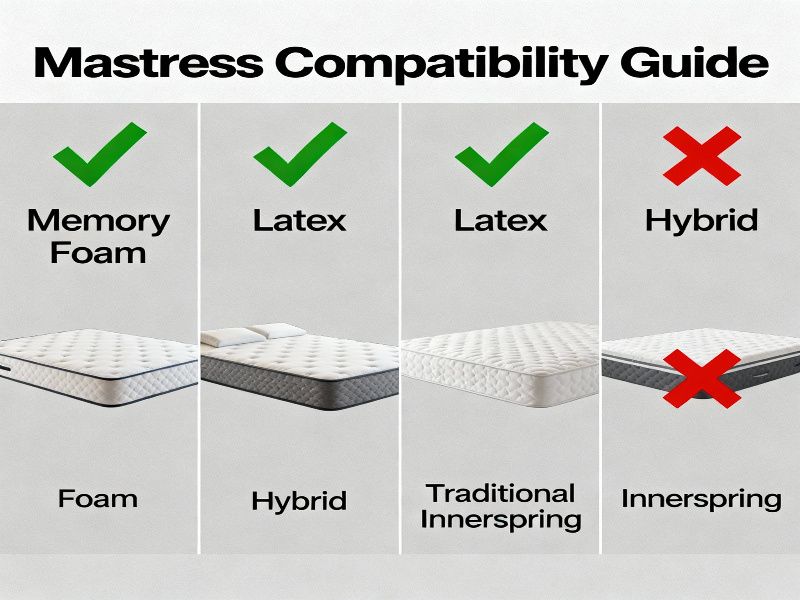
Memory foam mattresses are perhaps the ideal match for FOK959S-M adjustable bases. The foam’s flexibility allows it to conform smoothly to base adjustments without resistance or damage. Memory foam also provides the pressure relief that complements the positioning capabilities of adjustable beds—together they can significantly reduce pressure points and improve comfort. Most memory foam mattresses work fine on adjustable bases, though firmer models may resist extreme angles.
Latex mattresses also work well, particularly those without extensive quilting or pillow tops. Latex naturally flexes smoothly and returns to shape without developing permanent creases. The material’s durability means it handles repeated adjustment cycles without degrading faster than on a flat base. Natural latex is particularly popular with users prioritizing eco-friendly materials who still want smart bed functionality.
Hybrid mattresses combining foam or latex comfort layers with pocketed coil support systems can work, but compatibility varies. Look for models specifically marketed as adjustable-base-friendly. The individual coils need enough independence to flex with base adjustments without creating resistance or gaps. Thick comfort layers over the coils help mask any minor flexibility limitations of the coil system.
Mattresses to Avoid
Traditional innerspring mattresses with interconnected coil systems generally don’t work well on FOK959S-M adjustable bases. The rigid coil structure resists bending, creating stress on both the mattress and the base motors. You might get basic head elevation to work, but extreme positions become problematic and may damage the mattress or reduce motor lifespan. Some manufacturers explicitly void warranties if innerspring mattresses are used on their adjustable bases.
Very thick mattresses (over 14 inches) can be problematic regardless of construction. The additional weight strains motors and the extra thickness reduces the effective adjustment range—you get less actual position change because more movement is absorbed in compressing the thick mattress. If you prefer thick mattresses, verify your specific FOK959S-M variant can handle the weight and thickness before purchasing.
Mattresses with rigid foundations built in, like some pillow tops with substantial quilting or firm edge support systems, may not flex adequately. The built-in structure fights against base adjustments, creating uncomfortable gaps or ridges where the mattress can’t conform smoothly to the base position. When shopping, specifically ask about adjustable base compatibility if this information isn’t clearly provided.
Mattress Features to Consider
Look for mattresses with split designs if you’re sharing the bed with a partner who has different comfort preferences. Split king configurations give each person their own twin XL mattress and independent base controls—you can be elevated for reading while your partner lies flat, and mattress firmness can differ on each side. This is probably the single best feature for couples with different sleep preferences.
Cooling technology becomes more important with smart beds because the mechanical base can restrict airflow compared to traditional box springs. Mattresses with gel infusions, phase-change materials, or enhanced breathability help counteract this. The enclosed nature of many adjustable bases means heat dissipation isn’t as effective, so mattresses designed to sleep cool make a noticeable difference.
Edge support matters less on adjustable bases than on traditional platforms since you’re rarely sitting on the very edge of an adjusted bed. Manufacturers sometimes reduce edge reinforcement on adjustable-base-compatible models to improve flexibility without sacrificing practical support for the sleeping surface itself. This represents a reasonable trade-off for the application.
Health Benefits and Use Cases
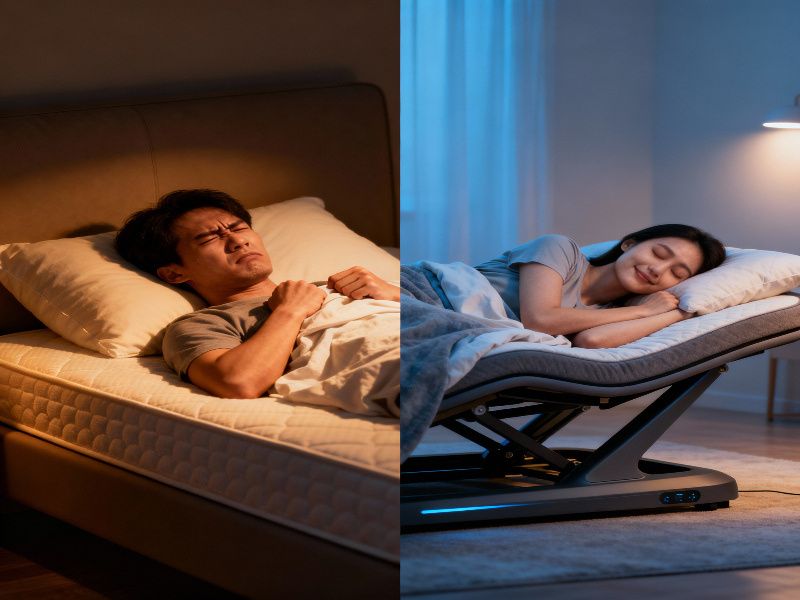
Beyond the technological appeal, FOK959S-M smart bed systems offer genuine health benefits for various conditions. Understanding these applications helps determine whether investing in this technology makes sense for your specific situation.
Sleep Apnea and Snoring
Elevating the head section helps keep airways open during sleep, reducing both snoring and sleep apnea episodes for many users. The effect isn’t dramatic enough to replace CPAP therapy for diagnosed sleep apnea, but it can reduce severity and may help with mild cases or occasional snoring. Partners benefit too—sleeping next to someone who snores less makes a real difference in their sleep quality.
The ability to adjust position during the night matters here. If you start snoring as you shift positions, a partner can bump the bed adjustment slightly without fully waking you, often enough to quiet the snoring. Some FOK959S-M systems with advanced sensors can make these adjustments automatically, though the automatic features work with varying degrees of success depending on the system sophistication and individual response patterns.
Acid Reflux and GERD
Gastroesophageal reflux disease (GERD) and general acid reflux improve significantly with head elevation. Gravity helps keep stomach acid where it belongs rather than allowing it to flow back into the esophagus during sleep. Medical recommendations typically suggest elevating the head of the bed by 6-8 inches for reflux management—the adjustable positioning of FOK959S-M beds makes achieving and maintaining this elevation straightforward.
What makes adjustable beds better than propping up on pillows is the angle continuity. Pillows create a bend at your waist that can actually increase abdominal pressure and worsen reflux. Adjustable beds raise your entire upper body on a smooth incline, maintaining proper spinal alignment while using gravity to manage reflux. Users with chronic reflux often report this as one of the most immediately noticeable benefits of smart bed technology.
Back Pain and Spinal Issues
Chronic back pain sufferers benefit from the ability to find and maintain optimal sleeping positions. Different back conditions respond to different positions—some people need lumbar support, others benefit from knee elevation that reduces pressure on the lower back, and some find relief in zero-gravity positioning that distributes weight evenly. The FOK959S-M system lets you experiment until you find what works for your specific condition.
The ability to adjust position throughout the night matters for back pain management. What feels comfortable initially might become uncomfortable after several hours in the same position. Being able to make small adjustments without getting out of bed helps maintain comfort and reduces sleep disruption. Some users set gradual position changes on timers to prevent pressure buildup in any one position.
Circulation and Swelling Issues
Leg elevation improves venous return and reduces swelling in ankles and feet—particularly valuable for people who retain fluid, have circulation issues, or spend long days on their feet. Elevating legs above heart level encourages fluid drainage and reduces the pooling that causes discomfort and swelling. Regular elevation during sleep can noticeably reduce morning stiffness and swelling.
The combination of elevation and massage features in many FOK959S-M systems provides additional circulation benefits. Gentle vibration massage stimulates blood flow and can help prevent the stiffness that develops from being in one position too long. While not a substitute for medical treatment of serious circulation problems, these features provide meaningful symptom relief for many users.
Mobility Limitations
For people with limited mobility due to age, injury, or chronic conditions, the FOK959S-M system makes getting in and out of bed substantially easier. Raising the head section helps transition from lying to sitting, reducing the effort and strain of sitting up from a flat position. The ability to adjust position without physically shifting your body reduces pain and difficulty for people with arthritis, joint problems, or post-surgical limitations.
Caregivers also benefit—adjustable beds reduce the physical strain of helping someone reposition, and the emergency flat function on medical-grade variants facilitates care during emergencies. The independence these beds provide to users with limited mobility represents significant quality-of-life improvement, allowing them to control their own comfort rather than requiring assistance for every position change.
Maintenance and Troubleshooting
FOK959S-M smart bed systems are generally reliable, but they do require some basic maintenance and occasional troubleshooting. Understanding common issues and their solutions helps you keep your system operating smoothly.
Routine Maintenance
Keep the motors and mechanical components clean and free of dust accumulation. Vacuum under and around the bed regularly to prevent dust from building up on moving parts where it can act as an abrasive. Some manufacturers recommend occasional lubrication of pivot points with silicone spray or light machine oil—check your manual for specific recommendations.
Inspect electrical connections periodically, particularly if you notice any intermittent operation. Connectors can work loose over time from the constant motion and vibration of adjustments. Tighten any loose connections and ensure cables aren’t being pinched or stretched during normal operation. Look for signs of wear on cables, particularly at points where they might rub against frame components.
Software updates occasionally become available for FOK959S-M systems with app connectivity. These updates might fix bugs, add features, or improve performance. Check for updates every few months through the companion app and install them when convenient. Updates typically take just a few minutes and don’t require any special knowledge—the app guides you through the process.
Common Issues and Solutions
If the bed isn’t responding to remote commands, start with simple checks. Replace remote batteries even if they seem fine—weak batteries cause intermittent operation that’s frustrating to diagnose. Verify the remote has clear line-of-sight to the receiver unit and that nothing is blocking the signal path. If you have an app-controlled system, verify your phone’s Bluetooth or Wi-Fi connection to the bed is active.
Unusual noises during operation often indicate mechanical issues. Clicking or popping might be joints that need lubrication or hardware that’s worked loose. Grinding sounds suggest misalignment or something interfering with moving parts. Whining motor sounds could indicate overload from a too-heavy mattress or motor bearing wear. Stop using the bed if noises are severe and contact support or service before further operation potentially worsens damage.
If one section moves but another doesn’t, the problem is likely isolated to that motor or its control circuit. Verify connections to the non-functioning motor are secure. Try swapping motor connections at the control box with a working motor—if the problem moves with the connection, the issue is in the control box; if it stays with the motor, the motor needs replacement. This diagnostic swap helps identify which component needs service.
Sleep tracking data that seems inaccurate might result from sensor placement or interference. Verify sensors are positioned correctly per manufacturer specifications and that nothing is blocking or covering them. Heavy mattress toppers can sometimes interfere with sensor operation. Some systems need recalibration if you’ve changed mattresses or made significant changes to bedding configuration.
When to Contact Support
Contact manufacturer support for persistent issues that basic troubleshooting doesn’t resolve, any signs of electrical problems like burning smells or sparking, structural concerns like frame cracks or unstable joints, or major motor failures. Most manufacturers provide substantial support during warranty periods and can walk you through advanced diagnostics or arrange service if needed.
Keep your purchase documentation, model number, and serial number easily accessible when contacting support. The more specific information you provide about symptoms and circumstances when problems occur, the more effectively support can help. Photos or videos of problems in action can be valuable for remote diagnosis.
Cost Considerations and Value Assessment
FOK959S-M smart bed systems represent a significant investment compared to traditional beds. Understanding the cost structure and value proposition helps you determine whether the investment makes sense for your situation.
Price Ranges by Variant
Entry-level FOK959S-M1 systems typically start around $800-$1,200 for a queen size, including the adjustable base but not the mattress. These basic systems provide fundamental adjustability without extensive smart features, making them accessible for budget-conscious buyers who want core functionality.
Mid-range FOK959S-M2 variants generally run $1,500-$2,500 for queen size bases. This pricing includes dual-motor systems, wireless remotes, USB ports, and often basic app connectivity. This tier represents the best value for most users—you get substantial functionality without paying premium prices for features you might not use.
Premium FOK959S-M3 systems range from $2,500-$4,000 or more for queen sizes. The higher cost reflects quad-motor systems, advanced massage features, comprehensive app integration, and better build quality. If you’ll actually use the advanced features and you prioritize sleep quality enough to justify the investment, the premium variants deliver meaningful improvements over mid-range options.
Medical-grade FOK959S-M4 variants are the most expensive, often exceeding $5,000 and sometimes reaching $8,000-$10,000 with all options. These are specialized products generally purchased through medical equipment suppliers with insurance assistance. For residential use without specific medical requirements, the consumer variants provide better value.
Additional Costs to Consider
Don’t forget mattress costs in your budget. Compatible mattresses range from $500 for basic memory foam to $2,000+ for premium hybrids or specialized sleep technology mattresses. If you’re replacing an existing bed entirely, you need to budget for both the adjustable base and a compatible mattress—total system costs can easily reach $3,000-$5,000 or more.
Some manufacturers charge separately for delivery and professional installation, ranging from $100-$300 depending on location and complexity. While self-installation is possible, professional setup ensures everything works correctly and saves you several hours of work. Extended warranties beyond manufacturer coverage typically cost $150-$300 and may provide value given the mechanical and electronic complexity of these systems.
Operating costs are minimal—the motors and electronics draw little power in standby mode and reasonable power during adjustment cycles. Expect perhaps $10-$20 annually in electricity costs for typical use. Maintenance costs should be negligible during warranty periods, though motor replacements or repairs after warranty expiration might run $200-$500 depending on what needs service.
Value Assessment
Whether FOK959S-M smart bed technology represents good value depends entirely on your personal circumstances. If you have chronic sleep issues, health conditions that benefit from adjustable positioning, or mobility limitations that make bed adjustment difficult, the system can provide tremendous value that justifies the investment. Improved sleep quality and reduced pain translate directly to better daily function and quality of life.
For healthy individuals without specific sleep issues, the value calculation becomes more subjective. The convenience and luxury of adjustable positioning is enjoyable, but it’s harder to quantify tangible benefits compared to good traditional bed. If you spend substantial time in bed reading or watching TV, the adjustable positioning adds real value. If you’re in bed purely for sleep and don’t have comfort issues, the benefits might not justify the premium.
Consider longevity in your value assessment. Quality FOK959S-M systems should provide 7-10 years of reliable service with proper care, comparable to the lifespan of good traditional beds. The electronics might become dated, but the mechanical functionality remains relevant. Spreading the cost over 8-10 years makes the investment more palatable—perhaps $300-$500 annually for a premium system that you use every night. For more help evaluating options, check our guide on choosing the right FOK959S-M model for your needs.
User Experiences and Real-World Performance
Technical specifications tell part of the story, but real-world user experiences provide valuable context about what living with FOK959S-M smart bed technology is actually like.
Adjustment to Smart Bed Life
Most users report an adjustment period of one to three weeks after switching to an FOK959S-M smart bed. The first few nights feel different—not necessarily bad, just different from a traditional flat bed. Some people immediately love the adjustability and wonder how they lived without it. Others need time to find positions that work for them and adapt to the sensation of sleeping on an adjustable surface.
The remote or app control becomes second nature quickly. After a week or so, adjusting your bed position becomes as automatic as adjusting pillows—you do it without really thinking about it. The convenience of preset positions grows on you as you realize you can achieve perfect comfort with a single button press rather than spending several minutes manually arranging pillows and body position.
Long-Term Satisfaction
Long-term user satisfaction with FOK959S-M smart beds is generally high among people who purchased systems appropriate for their needs. Users with specific health issues that prompted the purchase—back pain, reflux, sleep apnea—typically report sustained benefit and consider the system essential to their sleep quality. These users often say they can’t imagine going back to traditional flat beds.
People who purchased primarily for the technology appeal or luxury factor show more variable satisfaction. Some use the advanced features regularly and appreciate having them. Others find they rarely adjust the bed after initial novelty wears off and basically use an expensive adjustable bed as a flat bed most of the time. This doesn’t mean they regret the purchase—comfort levels remain high—but it suggests careful assessment of whether you’ll actually use advanced features before paying premium prices for them.
Couples show interesting patterns—split configurations with independent controls receive overwhelmingly positive feedback because each person gets exactly what they want. Single-control systems on shared beds create friction when partners have different preferences about positioning. If you’re sharing a bed, strongly consider split configurations even though they cost more—the relationship harmony benefit alone often justifies the additional investment.
Common Complaints and Limitations
The most common complaint involves the space between base sections when adjusted creating slight gaps or pressure points. Quality mattresses minimize this, but some users remain sensitive to where sections meet, particularly in extreme positions. Sleeping across adjustment seams can be uncomfortable for some people, though most adapt or find positions that avoid the issue.
Noise during adjustment bothers some users. While modern FOK959S-M systems are quieter than older adjustable beds, they’re not silent. If you’re adjusting position while your partner sleeps, the motor noise might wake them. Night-time automatic adjustments from anti-snore features occasionally disturb light sleepers even though the adjustment is gradual.
App connectivity issues frustrate users when they occur. Most systems work reliably, but occasional connection drops, app crashes, or firmware update problems do happen. When they do, reverting to the physical remote always works, but losing smart features even temporarily disappoints users who’ve come to rely on app control and sleep tracking.
Frequently Asked Questions
What makes FOK959S-M smart beds different from regular adjustable beds?
FOK959S-M systems include advanced control electronics that enable app connectivity, sleep tracking, smart home integration, and automatic adjustments based on sensor input. Regular adjustable beds typically just have basic motor controls without smart features.
Will my existing mattress work with a FOK959S-M adjustable base?
Memory foam, latex, and adjustable-base-compatible hybrid mattresses usually work well. Traditional innerspring mattresses with interconnected coils generally don’t work properly and may be damaged by adjustment cycles. Check with the base manufacturer about your specific mattress.
How difficult is installation?
Most people with basic tool skills can install FOK959S-M systems with help for heavy lifting. Assembly takes 2-4 hours typically. Professional installation is available and recommended if you’re not comfortable with assembly or electrical connections.
Do smart beds require internet connection to function?
Basic functionality works without internet—you can always adjust the bed manually with the remote. Internet connectivity enables app control, sleep tracking, smart home integration, and software updates, but isn’t required for core operation.
Are FOK959S-M smart beds worth the cost?
For people with health conditions that benefit from adjustable positioning—back pain, reflux, sleep apnea, circulation issues—the value is substantial and typically justifies the investment. For healthy individuals without specific sleep issues, value depends on personal priorities regarding comfort and technology.
How long do FOK959S-M systems typically last?
With proper care, expect 7-10 years of reliable service from quality systems. Motors and electronics are the most likely components to need eventual replacement, while frames typically last longer. Warranty coverage usually ranges from 3-10 years depending on the component and manufacturer.
Can I use an FOK959S-M smart bed with my CPAP machine?
Yes, smart beds work fine with CPAP therapy. In fact, the head elevation capability often reduces CPAP pressure requirements and makes CPAP use more comfortable. Just ensure tubing has adequate slack to accommodate bed adjustments without creating tension.
Conclusion
The FOK959S-M model represents a significant evolution in sleep technology, bringing sophisticated control systems, sensors, and smart features to adjustable bed platforms. For the right users, this technology delivers meaningful improvements in sleep quality, comfort, and health outcomes that extend far beyond the novelty of having a “smart” bed.
Understanding what the different FOK959S-M variants offer helps you match system capabilities to your actual needs. Entry-level systems provide essential adjustability for people on budgets. Mid-range variants deliver the features most users actually benefit from at reasonable prices. Premium and medical-grade systems serve specific needs where their advanced capabilities justify higher costs. To properly identify which type you have or need, refer to our guide on finding your model number.
The real value in FOK959S-M smart bed technology comes from addressing specific sleep challenges and health conditions rather than from the technology itself. If you’re dealing with back pain, reflux, snoring, circulation issues, or mobility limitations, the ability to precisely position yourself and monitor your sleep provides tangible benefits. The investment makes sense when improved sleep quality translates to better daily function and quality of life.
For those considering a purchase, be realistic about which features you’ll actually use. The appeal of comprehensive smart functionality is real, but if you’re unlikely to regularly check sleep tracking data or adjust settings through an app, paying premium prices for those features might not represent good value. Focus on the core adjustability benefits and health applications that prompted your interest in smart beds, then select a variant that delivers those capabilities reliably.
Installation and setup require some time and effort but are manageable for most users, particularly with help. Once operational, maintenance requirements are minimal and the systems prove quite reliable. The occasional troubleshooting required for any electronic system applies here, but shouldn’t deter you if the core functionality addresses your needs.
Ultimately, FOK959S-M smart bed technology succeeds by combining proven adjustable bed benefits with modern control systems and monitoring capabilities. It’s not just technology for technology’s sake—when properly matched to user needs, these systems genuinely improve comfort and sleep quality night after night. For comprehensive information about the complete FOK959S-M platform across all applications, return to our main guide which provides the full technical and practical context for this versatile model designation.




More Stories
Best Budget Mechanical Keyboards in 2026: What to Buy (and What to Avoid)
Vimeo to MP3 Converter: Best Tools That Actually Work (Free & Online)
How to Combine Videos on iPhone