
Quick Overview: What Does Tristan Mean?
If you just want the one-line version, Tristan is generally understood to be a name of Celtic origin, historically linked to ideas like “noise,” “tumult,” or “clashing”, and later associated—through French and Latin influences—with “sadness” or “sorrowful.”
That’s the simple summary, but it’s also a bit too neat. In reality, the name has several layers:
-
- Celtic/Brittonic roots: Traditionally tied to forms like Drust, Drustan, or Drystan, meaning something like noise, tumult, or clash.
-
- Folk association with Latin: Later connected to Latin tristis (“sad”), which shaped how medieval writers explained the name in tragic love stories.
-
- Legendary influence: The name’s emotional tone today is heavily shaped by the story of Tristan and Isolde, one of the most enduring tragic romances in European literature.
So when someone says, “Tristan means sad,” they’re not completely wrong—but they’re also skipping half the story. And the older half, in many ways.
Celtic Roots: Drust, Drystan, and the “Noisy One”
To understand Tristan properly, it helps to start in the Celtic world rather than in Latin or French. The name is widely traced back to Old Welsh and Brittonic forms like “Drystan” or “Drustan,” derived from an older root “Drust” or “Drest.”
That earlier root is generally interpreted along the lines of:
-
- “Noise” or “tumult”
-
- “Outcry” or “clashing”
-
- Sometimes more figuratively as “the clashing one” or “one who causes a tumult”
The Celtic world used strong, sometimes rough-sounding names for warriors and leaders. A name linked with noise or clashing might have suggested someone familiar with battle, someone whose presence stirred things up. Not a quiet background character.
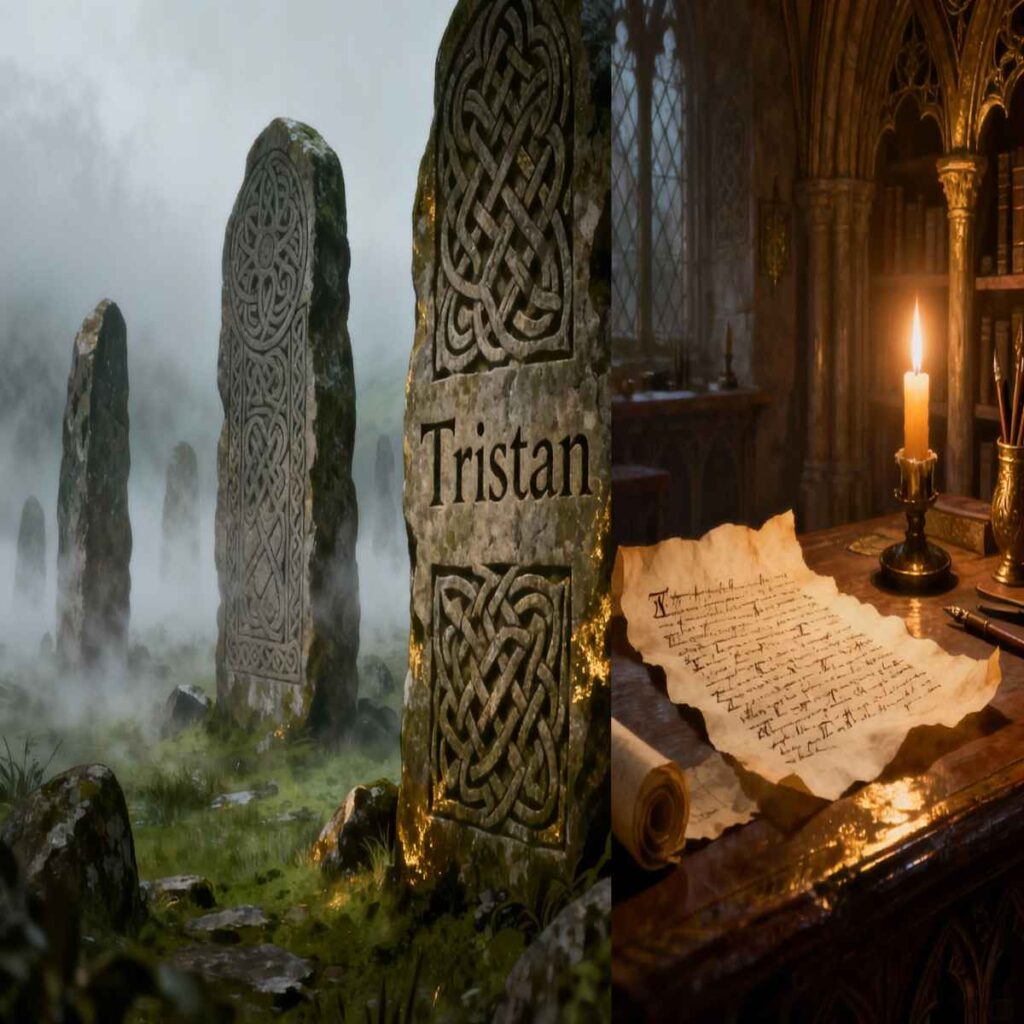
The Tristan Stone and Early Historical Echoes
There’s also a tangible piece of evidence that names like Tristan/Drustan weren’t just literary inventions. In Cornwall, there’s a famous 6th-century granite pillar often called the Tristan Stone, inscribed with a Latinized version of the name: Drustanus.
The inscription mentions “Drustanus, son of Cunomorus,” suggesting that a person with this name (or a closely related form) was significant enough to be commemorated. It doesn’t prove the later legends are historically exact, but it anchors the name in real geography, real time, and a Christianized Celtic environment.
From there, the name appears in various early forms across Brittonic and Pictish traditions—“Drest,” “Drust,” and so on—sometimes attached to kings or semi-legendary rulers in the Pictish lists.
From Drystan to Tristan: How the Name Evolved
Names don’t survive intact for more than a thousand years without changing, especially when they cross languages. Tristan’s journey from “Drust/Drystan” into the familiar modern form went through a few key phases.
Phase 1: Brittonic to Old French
As British and Breton stories traveled into northern France, especially in the 12th century, storytellers began shaping the old Celtic names into forms that fit Old French phonetics and spelling.
“Drystan” or “Drustan” becomes “Tristan” or “Tristran” in Old French texts, especially in early romance literature. The “Dr-” to “Tr-” shift is not unique to this name; sound changes like that are fairly common when names cross language boundaries.
[7][1]
Phase 2: Influence of Latin and French “Sadness” Words
Once the name existed as Tristan in French, something subtle but important happened: people began to associate it with words they already knew—in this case, Latin tristis (“sad”) and Old French triste (“sad”).
This didn’t change the core historical origin, but it did influence the perceived meaning, especially in literary retellings. Medieval authors leaned into this link. One famous German version explains that the hero is named Tristan because of the sorrowful circumstances of his birth—his mother dies in childbirth after hearing of her husband’s death in battle.
That’s not linguistically rigorous etymology; it’s storytelling. But stories shape how later generations hear a name. So “Tristan” started to feel like “the sorrowful one” even if its roots were more about noise and clashing than sadness.

Legendary Tristan: The Knight, the Lover, the Tragedy
Even if you don’t know the details, you might have a vague sense that Tristan belongs to the same world as King Arthur. That’s not an accident. The character we think of as Tristan is a central figure in Arthurian romance and especially in the story of Tristan and Isolde (sometimes spelled Iseult).
In the common versions of the story, Tristan is a knight of Cornwall who:
- Serves his uncle, King Mark of Cornwall
- Travels to Ireland to escort Princess Isolde back for marriage to Mark
- Accidentally drinks a love potion with Isolde, causing them to fall deeply in love
- Struggles between loyalty, duty, and passion, ultimately leading to exile and death
It’s a tragic love story, retold across languages and centuries, and it’s one of the main reasons the name didn’t quietly disappear into medieval footnotes.
How the Legend Shaped the Name’s Meaning
Because the most famous Tristan is a tragic lover, the emotional tone of the name skewed toward sorrow, sacrifice, and doomed love. Later tellings, like Wagner’s opera Tristan und Isolde, doubled down on that mood.
That’s why modern baby name sites often define Tristan as:
-
- “Sad” or “melancholy”
-
- “Sorrowful” or “full of sorrow”
Technically, those are later associations built on top of the older Celtic roots, but they’re not random—they track with how the character’s story feels. Over time, the name and the narrative became tightly intertwined in European culture.
Etymology in Detail: A Layered Name
If we zoom in purely on etymology and ignore the romance for a moment, Tristan looks something like this:
-
- Proto-Celtic / Brittonic base: Something like *Drest or *Drust, with meanings around noise or tumult.
-
- Old Welsh form: Drystan, a personal name likely derived from that base.
-
- Latinized forms: Drustanus, seen in inscriptions like the Tristan Stone.
-
- Old French form: Tristran/Tristan, adjusted to fit French sound patterns.
-
- Folk etymology layer: Association with Latin tristis and French triste (“sad”), especially in medieval literature.
Some modern sources also suggest an interpretation along the lines of “the clashing one” or “one who makes a tumult,” trying to capture the original sense in a more expressive English phrase.
So if you wanted to summarize its layers honestly, you might say:
Tristan is a Celtic name originally tied to ideas of noise and tumult, later emotionally colored by medieval tragic romance and associated with sadness and sorrow in Latin and French contexts.
Meaning Across Cultures and Languages
As the name spread beyond its original Celtic context, different cultures layered their own nuances on top of it. The basic sound remained recognizable, but the spelling and feel shifted slightly depending on the language.
Common Variants
-
- Tristram – An older English form, seen in works like Tristram Shandy in the 18th century.
-
- Tristran – A medieval form, mostly seen in old French texts.
-
- Tristano – Italian version.
-
- Tristán – Spanish version, often with an accent mark.
-
- Tristão – Portuguese form.
-
- Drystan – A modern revival of the Welsh-like variant.
-
- Tristen / Tristian / Tristin – Modern English spelling variants.
Despite these spelling differences, the core idea tends to stay the same: a name with medieval and Celtic roots, romantic associations, and a slightly dramatic emotional tone.
Given Name vs. Surname
Tristan shows up both as a first name and as a family name in some traditions. As a surname in Spanish and French contexts, it often traces back to medieval personal names that were transmitted through Old French into Iberia and elsewhere.
So if someone’s last name is Tristan, there’s a decent chance they have some historical tie—at least on paper—to that whole tapestry of Celtic legend, French romance, and Latinized medieval naming habits.
Modern Usage: Popularity and Trends
Tristan is one of those names that feels old and literary, but it’s not stuck in the past. It has been quietly (and sometimes loudly) popular in various English-speaking countries over the last few decades.
Popularity in the US and Beyond
In the United States, Tristan climbed steadily during the late 20th century and spent several years in the top 100 boys’ names between about 2006 and 2014. It has dipped slightly since then, but it hasn’t vanished; it remains a familiar, modern-sounding choice rather than a forgotten relic.
Other notes from recent data and name resources:
-
- It’s commonly used for boys but increasingly seen as a gender-neutral or unisex option.
-
- It has a steady presence in English-speaking countries like the US and UK, as well as in France and parts of Europe.
-
- Celebrities such as actor Chris Hemsworth have chosen Tristan for their children, giving it some additional spotlight.
The modern appeal seems to come from a mix of factors: it’s easy to pronounce, feels romantic but not over-the-top, and has that “story behind it” factor that a lot of parents quietly look for.
Emotional Tone: Tumult, Sorrow, and Quiet Strength
Names aren’t just dictionary entries; they carry emotional tones. Tristan is a good example of that. Even if you didn’t know the literal etymology, most people would describe it as sounding:
- Strong but not harsh
- A bit melancholic or poetic
- Somewhere between romantic and heroic
When you combine the original “noise/tumult” sense with the later “sad/sorrowful” association, the name almost feels like a narrative in itself: someone who has walked through conflict and pain, who is marked by struggle but not entirely defined by it.
That’s part of why the name translates so smoothly into spiritual or reflective contexts. Even though it isn’t a biblical name, many people instinctively connect it with themes like perseverance, endurance, and redemption—ideas explored more deeply in the main guide on Tristan in the Bible.
Tristan and Spiritual or Faith Contexts
Since a lot of people searching for the origin and meaning of Tristan are also interested in faith, it’s worth briefly touching on that intersection—without pretending the name is explicitly scriptural (it isn’t).
From a values-based perspective, the older Celtic idea of “tumult” can be read as:
- Facing battles instead of avoiding them
- Living through conflict with courage
- Accepting that life isn’t always calm, but still moving forward
And the later “sorrowful” association can be reframed as:
- Honesty about pain and grief
- A sensitivity to suffering―your own and others’
- Awareness that deep love sometimes comes with deep cost
Those aren’t strictly “religious” concepts, but they align closely with how many spiritual traditions (including Christianity) talk about growth, character, and resilience. It’s one reason the name works well in Christian families, even though it doesn’t appear in Scripture—something explored at length in the article on whether Tristan is a good Christian name.
Quick Reference: Key Facts About Tristan
-
- Origin: Celtic / Brittonic, via Old Welsh and Pictish forms like Drust, Drystan, Drustan.
-
- Original Sense: Noise, tumult, clashing, outcry.
-
- Later Association: Sadness or sorrow, via Latin tristis and French triste.
-
- Cultural Anchor: The Arthurian hero of Tristan and Isolde—tragic knight and lover.
-
- Historical Evidence: Tristan Stone in Cornwall with the name Drustanus, 6th century.
-
- Modern Usage: Popular in the US, UK, and Europe; peaked in US top 100 boys’ names from 2006–2014, still widely used.
- Style: Romantic, slightly melancholic, but strong and dignified.
Should You Choose Tristan? A Practical View
So after all the history and etymology, the real-world question is usually simple: Is Tristan a good choice? From a purely meaning-and-origin perspective, it’s a name with:
- Deep historical roots rather than being invented last decade
- A clear connection to European literary and cultural history
- A layered meaning that combines conflict, emotion, and resilience
- Modern usability without feeling shallow or trend-chasing
If you’re someone who likes names with a story, Tristan absolutely qualifies. If you prefer names with clean, cheerful meanings (like “joy” or “light”), the sorrow and tumult elements might feel a bit heavy. It comes down to whether you see hardship and emotional depth as something meaningful to reflect in a name.
For readers coming from a Christian or spiritual perspective, it can help to balance this article with the more faith-focused look at Tristan in the Bible, which explores how the name’s themes line up with biblical ideas about suffering, perseverance, and hope.
Wrapping Up: A Name with History, Not Hype
The origin and meaning of Tristan aren’t as simple as “it means sad” or “it means warrior.” The reality is more nuanced: a Celtic name tied to noise and clashing, reshaped by French and Latin, carried into legend as a tragic knight, and then adopted into modern use as a strong, slightly poetic given name.
That complexity is part of its appeal. Tristan isn’t a name that arrived out of nowhere or rose purely because of pop culture. It has been whispered in monasteries, etched into stone, sung in operas, and printed on birth certificates across centuries.
If you’re exploring Tristan as a name for yourself, your child, or even a character, understanding its layered background gives you more to work with. You’re not just picking a sound—you’re tapping into a long thread of history and meaning. And if you want to go further into how that thread connects with faith, Scripture, and spiritual symbolism, the main article on Tristan in the Bible ties all of that together in a broader, more reflective way.




More Stories
Delete Text Messages on iPhone for Both Sides Not Working
Telegram Without Phone Number: What Actually Works
How to delete Text Messages On iPhone for Both Sides